
AFF INDUSTRY INSIGHT WEEKLY(#E07)
September 2026 Monthly Roundup

September’s most important developments were not isolated funding announcements. They showed an ecosystem deciding what it needs to scale: deeper payment rails, local licences, public-market exits, shared financial intelligence, resilient technology suppliers and more compute capacity. Capital remained available, but it moved selectively toward businesses with infrastructure, assets, regulatory standing or proven distribution. At the same time, Uber’s exit from Nigeria and Twiga Foods’ administration showed how quickly scale can unravel when the operating model beneath it stops working

Executive Summary
•Dangote Refinery’s IPO became September’s defining market event. The SEC approved a public offer of 4.1 billion shares at ₦525 each, targeting about ₦2.15 trillion. The offer opened on 14 September and immediately tested the capacity of digital investment platforms under mass retail demand.
• Funding recovered, but breadth did not. African technology companies raised more than $178.3 million across 33 recorded transactions in September. The continent also crossed $2 billion in year-to-date startup funding, but the strongest flows still clustered around a limited number of growth-stage and infrastructure businesses.
• Public markets moved closer to the centre of the technology story. MNT-Halan secured a temporary Egyptian Exchange listing and Kenya approved its first locally domiciled ETF, widening the month’s capital-market story beyond venture funding.
• Payment infrastructure became more open and more regulated at the same time. PAPSS expanded the argument for local-currency settlement, TerraPay and Alipay+ connected African wallets to global QR acceptance, South Africa rebuilt its payment-system governance, and Kenya proposed open-finance rules that could require banks and mobile-money providers to share customer data with licensed third parties.
• Technology risk moved beyond the bank perimeter. Nigerian regulators focused on joint financial intelligence and shared third-party dependencies, recognising that cloud providers, payment processors, fintechs and virtual-asset firms now sit on the same operational surface.
• AI strategy turned into an infrastructure question. Egypt committed to a $1 billion AI data centre, UduTech sourced GPU capacity from South Korea, and African organisations gained recognition for useful AI applications. The strategic question is no longer only who can build models, but who controls the energy, data, compute and suppliers beneath them.
• September also exposed the cost of weak unit economics. Uber left Nigeria and Uganda, Twiga Foods entered a formal insolvency process after raising about $185.4 million, while Kenya’s mobile-money agent network shrank even as digital usage increased. Thse developments showed that scale alone is not enough without a sustainable operating model.
1. Capital Returned, but It Stayed Concentrated
September produced a healthier funding headline than the quieter months earlier in the year: African startups raised more than $178.3 million across 33 transactions. By the third week of the month, year-to-date funding had crossed $2 billion, only weeks later than in 2023 and 2025 and well ahead of 2024. The recovery is real, but its structure matters. Capital increasingly split between high-conviction growth rounds and debt or asset-backed financing for businesses with visible cash flows.

ARC Ride secures $33.3 million for electric-mobility infrastructure
Kenyan electric-mobility company ARC Ride raised $33.3 million to expand its battery-swapping network beyond Kenya. The financing reinforced investors’ preference for infrastructure businesses with tangible assets and measurable utilisation. Battery swapping reduces charging downtime for motorcycle and three-wheeler riders and lowers the upfront cost of electrification by separating the vehicle from the battery. Read moreDebt is no longer a fallback
Debt now accounts for 41% of capital raised by African technology companies, up from 17% in 2019. Revenue predictability, harder equity diligence and new local capital channels are making debt attractive to founders who can service it without giving up more ownership. The shift is not automatically positive: debt rewards discipline but turns a weak business model into a repayment problem.A strong headline still hides a narrow market
The month closed with a more disciplined fundraising message. Founders were warned against announcing $1 million pre-seed targets without credible first commitments, in a market where early-stage investors increasingly test traction, governance and capital efficiency before writing a cheque. September’s funding recovery therefore does not mean the old venture market has returned; it means the bar for accessing it has moved.2. Public Markets Became Part of the Technology Strategy

MNT-Halan moves toward a domestic listing
The Egyptian Exchange approved the temporary listing of 1.6 billion shares in MNT Tech Holding for Financial Investments, the holding company for MNT-Halan’s Egyptian business. The approval gives the company six months to complete the offering and remaining listing requirements. Crucially, only the Egyptian unit is preparing to list; the parent and its overseas businesses remain private. The structure offers a practical model for African technology groups: list the mature domestic operation while retaining flexibility around regional subsidiaries. Read moreDangote Refinery’s IPO turned retail access into an infrastructure test
The SEC approved Dangote Refinery’s ₦2.15 trillion public offer, setting up one of Africa’s largest share sales. When subscriptions opened, heavy demand reportedly slowed digital investment platforms. The episode mattered beyond the refinery: it showed that digital access can broaden participation in capital markets, but only if identity, payments, allocation and platform capacity can withstand mass retail demand.Kenya approves its first locally domiciled ETF
The Nairobi Securities Exchange granted conditional approval for the WSA Banking Index ETF, which will track listed Kenyan banks. For fintechs and wealth platforms, the significance is product depth: digital investing becomes more useful when the local market offers low-cost, diversified instruments rather than only individual equities and fixed-income products. The ETF also broadens the monthly story from startup capital to the market infrastructure that can eventually fund exits. Read more3. Cross-Border Payments Moved Closer to Everyday Use

TerraPay and Alipay+ turn African wallets into global payment instruments
TerraPay and Ant International’s Alipay+ announced a partnership to connect 15 African wallets on TerraPay’s Xend network to Alipay+’s global merchant ecosystem. The practical change is that participating wallet users can scan and pay abroad without a card or a separate account. For African providers, domestic wallets become travel and trade products; for merchants, acceptance expands without integrating each wallet separately. Read morePAPSS proves the rail can work; adoption is now the hard part
PAPSS says it connects 30 countries, 24 central banks, about 200 financial institutions and more than 16 payment switches. Transactions that once took three to five days can settle in seconds, and the system says it has cut transfer costs by as much as 95%. The remaining friction sits with documentation, local compliance, liquidity and bank adoption. The technology can net and settle local-currency flows; the commercial and regulatory participants must still choose to use it.South Africa begins rebuilding who can participate in payments
South Africa is moving toward activity-based payment regulation, giving fintechs and non-banks a clearer path to provide services directly while raising expectations around licensing, resilience, fraud controls and data. Responsibilities once concentrated in the Payments Association of South Africa are shifting toward the Reserve Bank and Pay Inc., the designated national payments utility. Access is widening, but the cost of participation is becoming more explicit.Kenya proposes an open-finance reset
Kenya’s draft National Payment System Bill would require payment providers to build systems capable of securely sharing customer data with licensed third parties after consent. It also creates categories for payment initiation and account information services. If enacted, fintechs could compete for the customer relationship without holding the underlying account, while banks and mobile-money providers would have one year to make their systems interoperable.4. Regulation Shifted From Institutions to Systems

NFIU prepares a joint intelligence framework for the whole financial ecosystem
Nigeria’s Financial Intelligence Unit began developing a Joint Financial Intelligence Collaboration framework spanning banks, fintechs, insurers and virtual-asset service providers. The aim is faster information sharing against money laundering, terrorist financing and fraud. The framework recognises that illicit flows do not respect institutional categories: risk can move from a wallet to a bank, an insurer or a crypto platform within the same chain. Read moreThird-party technology became a concentration-risk issue
The CBN warned financial institutions that dependence on the same cloud providers, payment processors and technology vendors can create a shared point of failure. If one critical provider is disrupted, several institutions can fail at the same time even when their internal systems remain sound. The policy implication is wider due diligence, resilience testing, supplier visibility and recovery planning across the technology chain. Read moreFintech M&A comes with regulatory history attached
Sycamore founder Babatunde Akin-Moses warned that acquiring a microfinance bank means inheriting more than a licence and a customer base. Buyers also take on governance obligations, operational liabilities and the institution’s regulatory history. The lesson applies beyond microfinance: acquisition can accelerate market entry, but regulatory due diligence must be treated as part of commercial valuation.5. AI Strategy Became a Compute and Sovereignty Question

Egypt commits $1 billion to an AI data centre
Egypt announced a 200MW AI data-centre project built around Nvidia technology, with a 20MW first phase delivered by Vodafone Business, Elsewedy Electric and Cassava Technologies. The first phase is expected to cost about $200 million within a wider $1 billion programme. For African markets, the important question is not only capacity; it is technological dependence. Hardware, power, cloud architecture and financing partners determine where data sits and whose stack the country relies on. Read moreUduTech looks to South Korea for GPU supply
Nigerian infrastructure company UduTech signed with BARO AI to secure GPU capacity for African AI workloads. The deal reflects a wider shift from talking about AI adoption to procuring the infrastructure required to run it. Direct supplier relationships may help African businesses reduce dependence on hyperscaler queues, but they also make energy, maintenance, utilisation and currency exposure central to AI economics. Read moreHelpMum shows what useful African AI looks like
Nigerian health-technology organisation HelpMum Africa won the Prix Ars Electronica grand prize for AI for social impact. Its recognition provided a useful counterweight to infrastructure announcements: compute only matters when it supports applications people need. Maternal and infant health, local-language services and public-sector delivery remain areas where African data and operating context can create defensible products. Read more6. Platform Economics Faced a Hard Reset

Uber exits Nigeria and Uganda
Uber ended operations in Nigeria and Uganda on 2 September, closing a 12-year run in Nigeria. Rising fuel and maintenance costs, pressure on fares, competition and repeated regulatory friction made the independent-driver model harder to sustain. The exit reinforced a wider lesson: the interface is not the defensible part of mobility. Identity, driver economics, credit, payments, safety and locally tuned operations determine whether the platform survives.Twiga Foods enters administration after raising about $185.4 million
Twiga Foods entered administration after years of restructuring, job cuts and attempts to move away from the high-cost model on which it was built. The company used technology, warehouses and delivery fleets to connect farmers and suppliers with informal retailers, but the fixed costs of formal logistics struggled against thin margins and small daily orders. Its collapse is not an argument against digitising informal trade; it is a warning that software does not remove the economics of distribution.Kenya’s mobile-money market needs fewer agents as money stays digital
Kenya lost roughly 34,000 registered mobile-money agents between March and June even as subscriptions grew to 54.01 million. The shift reflects more money staying inside the digital loop through merchant tills, PayBill numbers, bank-to-wallet transfers and business wallets. The agent network remains important for cash conversion, but its role changes when consumers can receive, hold and spend digitally without visiting a counter.7. M&A and Market Entry Favoured Existing Infrastructure

CreditChek acquires Uganda’s Algosys
Nigerian credit-infrastructure company CreditChek acquired Ugandan core-banking software provider Algosys, gaining an operating base and relationships with 22 financial institutions. The deal expands CreditChek from assessment and data into origination and loan-management technology. It also illustrates why acquisition can beat greenfield expansion in regulated markets: customer relationships, local integrations and institutional trust take years to build. Read moreAccess Bank Kenya prepares to transfer its business back into NBK
Kenyan regulators approved a transaction under which Access Bank Kenya’s business, assets and liabilities will move to National Bank of Kenya, 16 months after Access completed its acquisition of NBK. The regulator framed the transaction around stability, resilience and competition.8. Other Developments That Mattered in September
Airtel Money moves toward a London IPO with IFC support
Airtel Money announced plans to list in London, with the International Finance Corporation committing up to $90 million as a cornerstone investor. The offer could raise about $800 million at an estimated valuation of $8 billion to $9 billion. The listing would give public-market investors direct exposure to a mobile-money platform serving roughly 53 million monthly active users across 13 African markets, while testing how well the business performs as a standalone financial-services company. Read moreBujeti launches AI agents for routine finance work
Y Combinator-backed Bujeti introduced four AI agents that can retrieve invoices and receipts, monitor transactions, chase unpaid invoices and answer employees’ finance questions using the accounts, budgets, vendors and contracts already held on its platform. The launch is a practical sign that enterprise AI is moving from general-purpose assistants into embedded financial operations, with human review retained for low-confidence outputs. Read moreRemita moves into consumer financial management
Remita launched a consumer app combining multi-bank account management, transfers, recurring payments, investments, retail-credit access, tickets, bills and personal money management. The move takes a long-established payments infrastructure provider closer to the customer interface and intensifies competition for the financial “home screen” rather than a single transaction type. Read moreFintech apps strengthen their hold on Nigerian smartphones
A KPMG and Orange Group Nigeria study found OPay on 69% of surveyed smartphones across 12 Nigerian cities, followed by PalmPay at 29%. Access Bank led individual traditional-bank apps at 16%. The comparison is not a measure of deposits or transaction value, but it is an important distribution signal: fintechs increasingly own the high-frequency mobile interface even where banks retain the primary financial relationship. Read moreStartup-support infrastructure attracts capital and AI
22 On Sloane launched KUMii, an AI platform designed to connect African startups and small businesses with funding, customers, mentors and support programmes, while announcing plans to raise $63 million through Sloane Capital. In the same month, Askya opened a zero-equity AI growth programme offering selected companies access to up to $200,000. Both initiatives target the same bottleneck: founders often struggle less with finding programmes than with converting fragmented support into customers, capital and distribution. Read more9. September by the Numbers
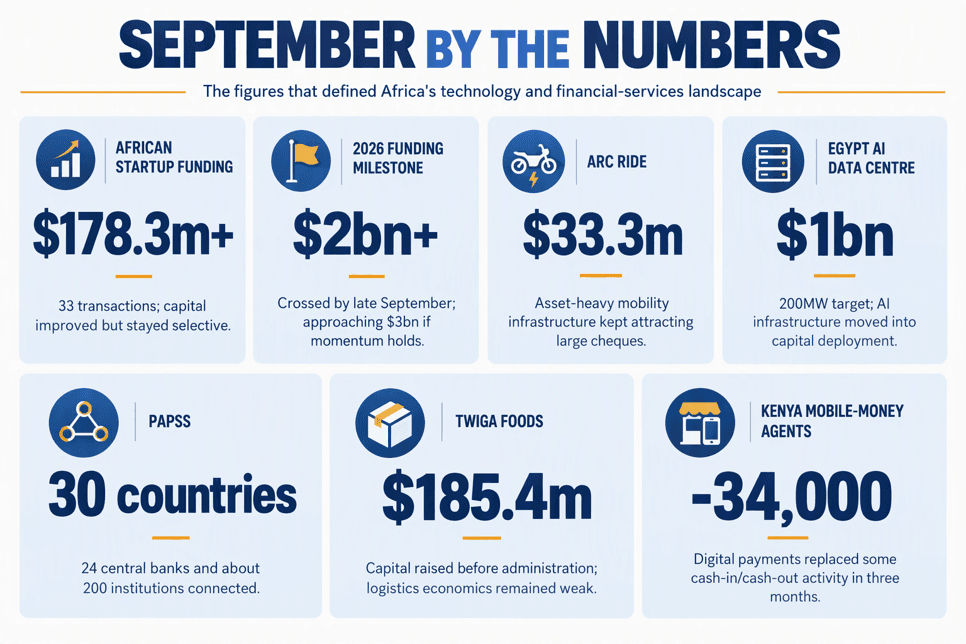
10. Defining Stories of September
- Dangote Refinery launches Africa’s largest-ever share sale: the ₦2.15 trillion offer widened retail access and exposed investment-platform capacity limits.
- African startup funding crosses $2 billion for 2026: recovery is visible, but capital remains concentrated.
- Uber exits Nigeria and Uganda: global scale could not overcome local unit economics.
- Twiga Foods enters administration one of East Africa’s best-funded startups becomes a warning about fixed-cost logistics.
- MNT-Halan moves toward an Egyptian listing: a domestic public-market route begins to look plausible for African fintech.
- Egypt commits $1 billion to AI compute: data-centre strategy becomes industrial policy.
- Kenya proposes open-finance rules: bank and mobile-money data could become accessible to licensed fintechs.
- TerraPay and Alipay+ connect African wallets to global QR acceptance: wallets move beyond domestic ecosystems.
- NFIU and CBN widen their risk perimeter: regulators focus on shared intelligence and technology dependencies.
Strategic Opportunities Emerging from September
1. Retail investment infrastructure. The pressure placed on digital investment platforms during the Dangote Refinery offer points to demand for stronger onboarding, identity verification, payments, allocation and investor-support systems that can handle high-volume public offers. There is room for products that make capital-market participation simpler without weakening compliance or reliability.
2. Cross-border payment and settlement services. TerraPay, Alipay+ and PAPSS show that the rails are expanding, but adoption still depends on liquidity, compliance alignment, merchant acceptance and simple customer experiences. Opportunities sit around local-currency settlement, wallet interoperability, trade payments and the services that connect businesses to these networks.
3. Open-finance and regulated data products. Kenya’s proposed framework could make customer-permissioned financial data available to licensed third parties. That creates space for account aggregation, cash-flow underwriting, personal financial management, fraud prevention and embedded-finance products built on secure consent and responsible data use.
4. Financial intelligence and third-party risk tools. The NFIU’s collaboration framework and the CBN’s warning on shared technology providers create demand for better transaction monitoring, supplier-risk visibility, resilience testing and intelligence sharing across banks, fintechs, insurers and virtual-asset firms.
5. AI compute and local infrastructure. Egypt’s data-centre commitment and UduTech’s GPU sourcing show that access to compute is becoming a commercial bottleneck. Opportunities extend beyond model development to data-centre capacity, GPU access, energy, cloud services, local-language applications and sector-specific AI for health, finance and public services.
6. Public-market readiness and IPO support. Dangote Refinery, MNT-Halan and Airtel Money show that public markets are becoming relevant to African technology and financial-services businesses. Opportunities include issuer-readiness support, retail distribution, custody, investor education, market-making, research, data rooms and digital offer infrastructure for companies preparing to list locally or abroad.
7. The financial-services home screen. OPay’s smartphone reach and Remita’s move into multi-bank financial management show that the competitive contest is shifting from individual products to the primary customer interface. Opportunities sit in account aggregation, everyday money management, loyalty, personalised offers, merchant services and partnerships that combine the trust and balance sheet of regulated institutions with the frequency of fintech distribution.
8. Embedded AI for finance operations. Bujeti’s finance agents point to a practical enterprise market for AI that handles invoices, reconciliations, collections, document retrieval, treasury alerts and policy questions. The strongest opportunities will combine automation with permission controls, audit trails, confidence thresholds and human review rather than treat AI as a standalone chatbot.
9. Credit infrastructure for SMEs and informal businesses. CreditChek’s acquisition, the growth of digital transaction records and open-finance proposals create room for cash-flow underwriting, loan-origination systems, collections technology and sector-specific credit. Partnerships can turn payments, merchant activity and supply-chain data into responsible lending without relying only on traditional collateral.
10. Climate and asset-backed finance. ARC Ride’s financing and the rise of debt across African technology point to opportunities in battery leasing, vehicle finance, renewable-energy equipment, cold-chain assets and other infrastructure with measurable utilisation. These models need structured finance, collections, insurance, asset tracking and secondary-market support as much as they need venture capital.
11. Startup distribution and commercialisation. KUMii and Askya highlight a gap between incubating startups and helping them win customers. Opportunities include structured proof-of-concept programmes, corporate procurement pathways, regulatory-readiness support, market-entry partnerships and sector sandboxes that move promising companies from mentorship to repeatable revenue.
What September Revealed
 September made the next phase of African technology easier to see
The most defensible opportunities are moving down the stack: payment interoperability, regulated data access, local licences, identity and risk infrastructure, compute, connectivity and capital-market rails. Product innovation still matters, but it increasingly sits on top of systems that are expensive to build, hard to regulate and difficult to replace.
September made the next phase of African technology easier to see
The most defensible opportunities are moving down the stack: payment interoperability, regulated data access, local licences, identity and risk infrastructure, compute, connectivity and capital-market rails. Product innovation still matters, but it increasingly sits on top of systems that are expensive to build, hard to regulate and difficult to replace.
For founders, the message is discipline. Large headline targets are less persuasive than credible first commitments, revenue quality and a visible path to sustainable margins. For banks and fintechs, the opportunity is partnership: shared rails and regulated access can grow the market faster than closed distribution. For policymakers, the challenge is coordination. Open finance, payment interoperability, AI sovereignty and third-party resilience cannot be solved by one regulator or institution acting alone.
September did not produce a single defining technology story. It produced a clearer map of the ecosystem: where capital will go, what regulation will demand, which infrastructure is becoming strategic and why scale without sound economics remains fragile.
From the Foundry
